Madrid
Madrid
Madrid – Strategically located in the geographic centre of the Iberian Peninsula at an altitude of 646 meters above sea level, Madrid (with a population of over 3 million residents) has one of the most important historic centers of all the great European cities. For European standards, Madrid is not a very old city, since Spain was not a unified country until 1492, and it didn’t become the capital of this country until King Philip made it so in 1561.
Before then, Madrid was a much smaller town which was a site of a small palace built by Moorish ruler Muhammad I of Córdoba during the 9th century, before it fell to Alfonso XI of Castile in 1083. That same palace was replaced by what’s now the Palacio Real – the official residence of the Spanish Royal Family – in the 1730s, with construction completed by 1764.
Near the Plaza Mayor is the area known as the “aristocratic centre” where the jewel in the crown is the Royal Palace, an imposing building dating from the 17th century featuring a mixture of Baroque and classic styles. Beside it is the Plaza de Oriente square, the Teatro Real opera house, and the modern cathedral of La Almudena which was consecrated in 1993 by Pope John Paul II.
Visitors going through Madrid will note that art and culture play a key role in the Spanish capital’s cultural life. Madrid has over 60 museums which cover every field of human knowledge — including the Prado Museum, one of the world’s most important art galleries; the Thyssen-Bornemisza Museum, with over 800 paintings ranging from primitive Flemish artists through to the avant-garde movements. There’s also the Reina Sofía National Art Centre, dedicated to contemporary Spanish art and containing works by Picasso, Joan Miró, Salvador Dalí and Juan Gris, among others.
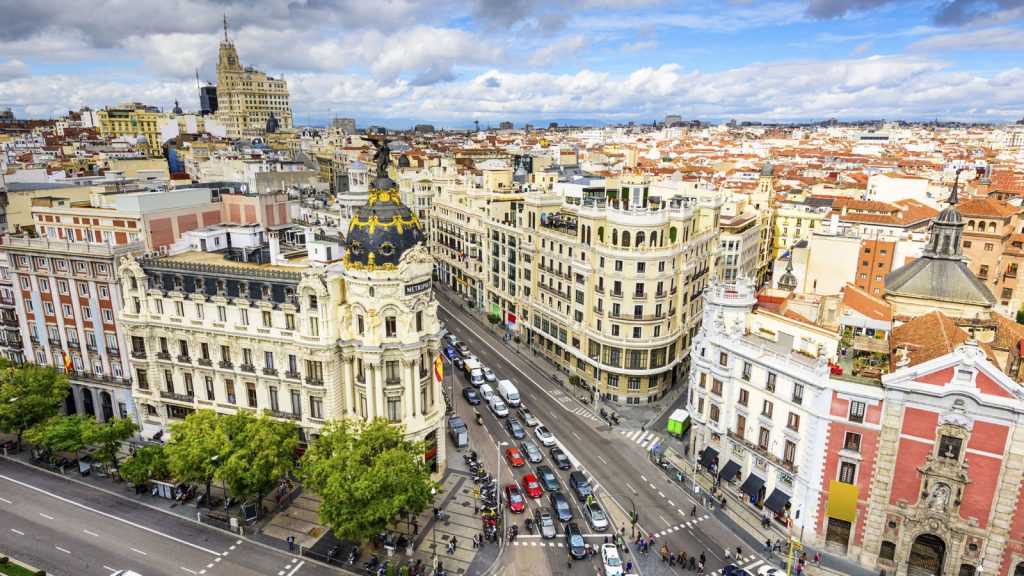
Madrid’s extensive and beautifully maintained parks and gardens –like the Retiro park (which was once the recreational estate of the Spanish monarchs), the Casa de Campo and Juan Carlos I park– lets both locals and visitors enjoy such green urban areas. Tourists seeing such sites will also be impressed by medieval-era public areas like Puerta del Sol, and broad avenues like Gran Via and Paseo de la Castellana (reputed to be the longest and widest avenue of Madrid).
Castellana’s importance in the city of Madrid is stressed not only by its commercial car traffic, but by the presence of various business, banking and financial buildings along that avenue (or at least within its proximity) – such as the AZCA office complex, and the Gates of Europa towers (a.k.a. KIO Towers – which acts as the unofficial northern entrance to the city). Along with such buildings, various Spanish government buildings are located there, along with Madrid’s football team Real Madrid’s state-of-the-art quality Santiago Bernabéu Stadium.